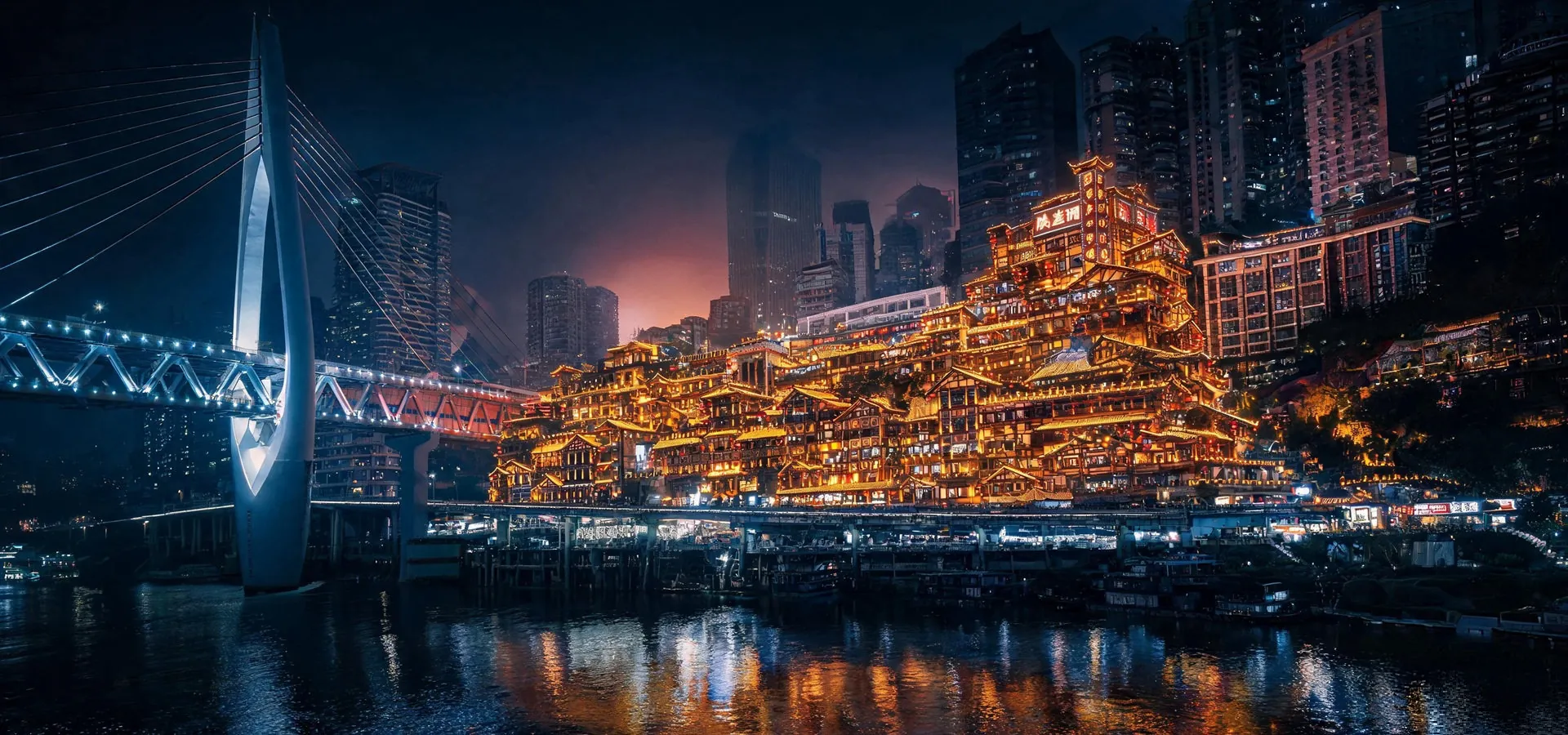
Chongqing — Where Mountains, Rivers & Fire Collide
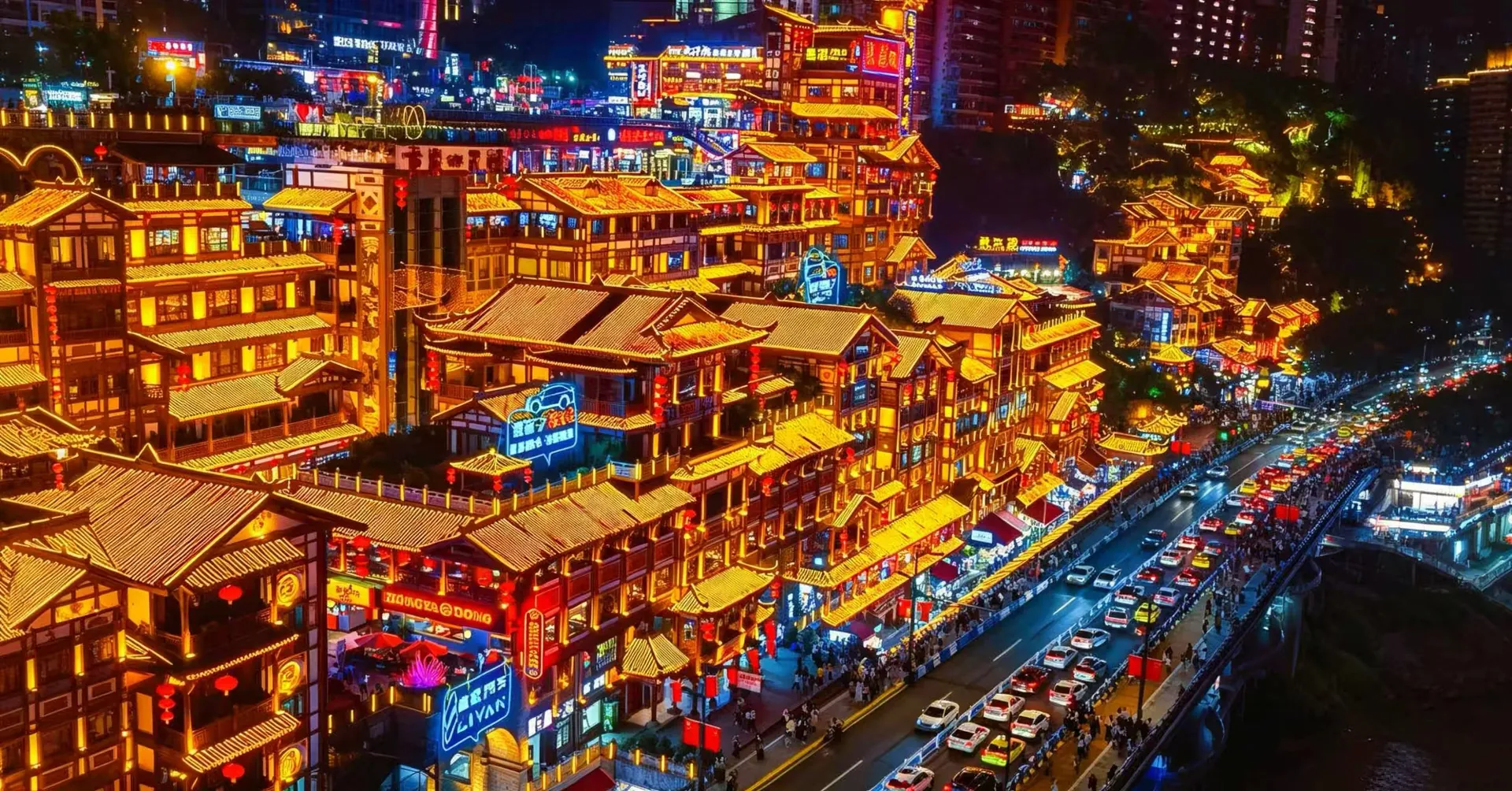
Chongqing defies logic. It's a city built vertically on mountains where your GPS will confidently announce "you have arrived" while you're on a bridge 50 meters above your actual destination. It's a megacity of **32 million people** whose skyline at night — a riot of neon, LED, and fog — has earned
Where is Chongqing?
Located in Southwest China with a population of 32.1 million.
See routes including Chongqing
When to Visit - Month by Month
| Month | Temp | Rain | Crowd | Rating | Tips |
|---|---|---|---|---|---|
| Jan | 5~10°C | Low | Low | ★★ | Cold. Foggy skyline |
| Feb | 7~13°C | Low | Low | ★★ | Still foggy |
| Mar | 11~18°C | Medium | Medium | ★★★★ | Spring begins |
| Apr | 15~24°C | Medium | High | ★★★★★ | Warm. Comfortable |
| May | 19~27°C | Medium | High | ★★★★ | Warm. May holiday |
| Jun | 23~30°C | High | Medium | ★★★ | Hot. Rain starts |
| Jul | 26~35°C | High | Medium | ★★ | Furnace heat |
| Aug | 26~34°C | High | Medium | ★★ | Hottest. Humid |
| Sep | 22~28°C | Medium | Medium | ★★★★★ | Best. Less humid |
| Oct | 17~23°C | Low | High | ★★★★ | Golden autumn |
| Nov | 12~18°C | Low | Medium | ★★★ | Comfortable |
| Dec | 7~12°C | Low | Low | ★★ | Cold. Misty |
Compare climate with other cities
Attractions - Ranked
Must-See (Don,t Miss These)
Hongya Cave at night
A stunning 11-story stilted wooden structure built into a cliff above the Jialing River. Inspired by traditional Diaojiaolou architecture, it transforms into a golden lantern at night - one of China''s most photographed scenes.
| Detail | Info |
|---|---|
| Open | 10 AM - 10:30 PM |
| Admission | Free |
| Getting there | Metro Line 1 to Xiaoshizi |
| Best time | 7-10 PM after dark |
Tip: Cross the Qianximen Bridge for the iconic skyline photo. The rooftop deck on the 11th floor offers great river views.
Chongqing Hot Pot experience
Chongqing''s culinary soul - bubbling red chili oil infused with Sichuan peppercorns. Locals dip raw ingredients into the communal pot. The city has 30,000+ hot pot restaurants.
| Detail | Info |
|---|---|
| Average cost | 60-120 yuan/person |
| Top restaurants | Qi Hot Pot, Pei Sister |
Tip: Order yuanyang pot (half spicy, half clear) if sensitive. The dipping sauce is sesame oil + garlic + vinegar. Must-try: goose intestine, tripe, and lotus root.
Yangtze River Cableway
Chongqing''s "air bus" - a cable car spanning the Yangtze River. The 1,166m ride takes 4 minutes with breathtaking views of the river and skyline.
| Detail | Info |
|---|---|
| Open | 7:30 AM - 9:30 PM |
| Fare | 20 yuan one way |
| Getting there | Metro Line 1/6 to Xiaoshizi |
Tip: Go at sunset. Stand near the left window going south for the best river view. Avoid weekends.
Worth a Visit (If You Have Time)
CiqiKou Ancient Town
Well-preserved Ming and Qing Dynasty old town on the Jialing River. Stone-paved lanes, courtyard houses, tea houses, and street food.
| Detail | Info |
|---|---|
| Open | 24/7, free |
| Getting there | Metro Line 1 to CiqiKou |
| Time needed | 2-3 hours |
Tip: Enter through the back streets (east side) for a less crowded experience. Try the local ma hua (fried twisted dough sticks).
Wulong Karst day trip
UNESCO World Heritage karst with Three Natural Bridges, Furong Cave, and a glass skywalk over sheer cliffs.
| Detail | Info |
|---|---|
| Open | 8:30 AM - 4:30 PM |
| Admission | 135 yuan |
| Getting there | Bus from Chongqing (3h) |
| Time needed | Full day |
Tip: Take the glass elevator down to the Three Bridges floor. Join a small group tour to avoid public transport hassles.
Eling Park viewpoint
The best free viewpoint in Chongqing. Hillside park where the Yangtze and Jialing Rivers converge, with panoramic skyline views.
| Detail | Info |
|---|---|
| Open | 6:30 AM - 9 PM |
| Admission | Free |
| Getting there | Metro Line 1 to Eling |
| Time needed | 1-2 hours |
Tip: Visit around 5 PM to watch the city lights turn on during sunset.
Suggested Itineraries
1 Day in Chongqing
| Time | Activity |
|---|---|
| 9:00-11:00 | CiqiKou Ancient Town |
| 11:30-12:30 | Lunch: Chongqing xiao mian |
| 1:00-2:30 | Yangtze River Cableway |
| 3:00-5:00 | Eling Park viewpoint |
| 6:00-7:00 | Pre-dinner walk on Jiefangbei |
| 7:00-9:00 | Hot pot dinner |
| 9:00-10:00 | Hongya Cave at night |
2 Days in Chongqing
| Time | Activity |
|---|---|
| 7:00 AM | Day trip to Wulong Karst (3h bus) |
| 9:00-3:00 | Three Natural Bridges + Glass Skywalk |
| 3:00-6:00 | Return to Chongqing, rest |
Day Trips
| Destination | Transport | Time | Why Go |
|---|---|---|---|
| Wulong Karst | Bus 3h | Full day | Natural Bridges + glass walk |
| Dazu Carvings | Bus 2h | Full day | UNESCO Buddhist carvings |
Food Guide
Chongqing cuisine is Sichuan cuisine's wilder sibling — hotter, numbier, and unapologetically intense. If Chengdu food is a controlled burn, Chongqing food is a grease fire. In the best way.
This is the reason to come to Chongqing. The city has over 30,000 hot pot restaurants — statistically, there's a hot pot joint for every 1,000 residents. Chongqing hot pot is distinguished by a broth dominated by beef tallow (牛油 / niúyóu) rather than vegetable oil, giving it a richer, more decadent mouthfeel. The nine-square grid pot (九宫格) is the traditional format — different zones for cooking different ingredients at different intensities.
Essential hot pot ingredients:
- 毛肚 (máo dù / beef tripe) — the #1 must-order; dip in bubbling broth for 10 seconds
- 鸭肠 (yā cháng / duck intestine) — crispy, snappy; 15 seconds
- 黄喉 (huáng hóu / aorta) — crunchy, flavor-absorbing
- 藕片 (ǒu piàn / lotus root) — sweet, crisp contrast to all that fire
| Restaurant | Area | Notes |
|---|---|---|
| Huang Jie Hot Pot (黄姐火锅) | Yuzhong District | The local legend — plastic stools, zero atmosphere, perfect broth |
| Pei Jie Hot Pot (佩姐老火锅) | Multiple locations | Tourist-friendlier; excellent quality, slightly milder spice |
If hot pot is Chongqing's dinner, xiǎomiàn is its breakfast. Thin wheat noodles in a bowl of fiery chili oil, Sichuan pepper, soy sauce, vinegar, garlic, crushed peanuts, and a handful of blanched greens. It costs ¥6–10, takes 60 seconds to prepare, and is consumed standing up at high speed. The best stalls are the ones with plastic stools on the sidewalk and a line of office workers at 8 AM.
A Chongqing original that translates literally to "hair blood prosper" — which tells you nothing useful. It's a bubbling cauldron of duck blood curd, beef tripe, ham, bean sprouts, and glass noodles, all swimming in a fiery málà broth. It's hot pot's more intense, unhinged cousin — a single serving rather than a communal pot. Intimidating, addictive, unforgettable.
Sweet potato starch noodles in a lip-puckering, sinus-clearing broth of black vinegar and chili oil, topped with fried soybeans, minced pork, and scallions. The texture is the star — the noodles are impossibly smooth and slippery, and the broth is so tangy you'll keep drinking it long after the noodles are gone.
| Restaurant | Area | Notes |
|---|---|---|
| Hao You Lai (好又来酸辣粉) | Jiefangbei | The gold standard — a tiny storefront with massive flavor |
Chongqing's jiānghú cài ("rivers and lakes cuisine") is bold, rustic, and unrefined in the best sense. The signature dish is Lazi Ji (辣子鸡 / chili chicken) from Geleshan Mountain — diced chicken buried under a mountain of dried chilies. You dig through the chilies hunting for crispy chicken morsels. It's as much a game as a meal.
Where to Stay
| Area | Vibe | Price Range | Best For |
|---|---|---|---|
| Jiefangbei & Hongya Cave (解放碑/洪崖洞) | The absolute center; walk to the CBD, Hongya Cave, and cableway | ¥400–1,500/night | First-time visitors, night photography |
| Nanbin Road (南滨路) | Riverside promenade on the south bank; views back toward the Yuzhong skyline | ¥500–1,800/night | River-view luxury, couples, photographers |
| Jiangbeizui (江北嘴) | New CBD, high-end hotels, quieter at night | ¥600–2,000/night | Business travelers, luxury seekers |
| Nan'an & Nanshan (南岸/南山) | Quieter hillside area; hot spring resorts, Nanshan viewpoint for the skyline | ¥300–1,000/night | Relaxation, mountain air, escaping the crowds |
Getting Around
| Method | Route / App | Notes |
|---|---|---|
| From Jiangbei Airport (CKG) | Metro Line 10 → transfer to Line 3 or 6 | 50–70 min, ¥7 |
| From Jiangbei Airport (CKG) | Taxi / DiDi | 40–60 min, ¥60–100 |
| Metro & Monorail | Alipay Transport or "渝畅行" app | 10+ lines; the monorail (Lines 2 & 3) gives the best views |
| Taxi ("Yellow Ferrari") | Street hail or DiDi | Chongqing taxi drivers are legendarily fast — hold on, and enjoy the ride |
| Navigation Warning | — | Google/Apple Maps struggle with vertical Chongqing. Always add 20% to any estimated travel time. When in doubt, ask a local — they navigate this impossible city by instinct |
Unique Experiences
| Experience | Why It's Worth It |
|---|---|
| Yangtze River Cableway at sunset | Four minutes suspended above the Yangtze with the skyline turning gold then neon — the most cinematic ¥20 you'll ever spend |
| Hongya Cave from Qiansimen Bridge | The shot that defines Chongqing on Instagram — arrive 30 minutes before sunset to claim your spot on the bridge railing |
| Dongzi Hot Pot (洞子火锅) | Hot pot restaurants built inside old bomb shelters and caves — a uniquely Chongqing experience. The constant temperature underground stays cool even in summer |
| Nanshan Viewpoint (南山一棵树) | The panoramic skyline observation deck; go on a clear night for the full cyberpunk effect. Yihuali Night Park (壹华里夜景公园) is a newer alternative with better photo spots |
| Wulong Karst day trip | Descend into a geological wonderland — natural stone bridges, slot canyons, and thundering waterfalls, all within a morning's journey from the city |

Souvenirs
| Souvenir | What It Is | Where to Buy |
|---|---|---|
| Hot Pot Base (火锅底料) | Chongqing-style beef tallow blocks; Qiaotou (桥头) and Mingyang (名扬) are top brands | Supermarkets, Ciqikou, airport |
| Chen Mahua (陈麻花) | Ciqikou's famous twisted fried dough — sweet, salty, and spicy varieties | Ciqikou Ancient Town (the original shop has the longest queue) |
| Hechuan Peach Slices (合川桃片) | Delicate layered pastries of glutinous rice, walnuts, and sugar — a local sweet specialty | Supermarkets, Ciqikou |
| Jiangjin Rice Candy (江津米花糖) | Crispy puffed rice bars with peanuts and malt sugar | Supermarkets, local snack shops |
| Fuling Zhacai (涪陵榨菜) | China's most famous pickled mustard tuber — a pantry staple nationwide; the gourmet versions in gift boxes make a quirky souvenir | Supermarkets |
| Rongchang Folding Fan (荣昌折扇) | Handmade bamboo and paper folding fans — a traditional Chongqing craft | Ciqikou artisan shops |
Before You Go - Checklist
Travel Styles
¥50 dorm beds, ¥6 xiaomian breakfast, free Hongya Cave views from Qiansimen Bridge. Chongqing hot pot split among friends is ¥50–80/person. Full budget guide →
The monorail through a building (Liziba Station) fascinates kids. Wulong Karst is a family-friendly nature day trip. Order yuanyang (half-spicy) hot pot. Full family guide →
Major manufacturing and logistics hub. Stay in Jiangbeizui CBD. The fastest business lunch is xiaomian (¥6, 5 minutes). Chongqing Jiangbei Airport (CKG) has growing international connections. Full business guide →
This is a vertical city — lots of stairs. Use DiDi instead of walking between levels. The Yangtze Cableway and Wulong Karst day trip are seated experiences. Full seniors guide →
Related
Routes: Golden Route | Themed routes Info: Visa | Payment | Internet
Have you been to Chongqing?
What experience would you tell every traveler not to miss?
More Cities to Explore
Chengdu Travel Guide: Pandas, Hot Pot & China's Most Relaxed City
Chengdu travel guide for foreigners: pandas, hot pot, teahouses & Sichuan opera. Must-see attractions ranked, 1-3 day itineraries, where to eat and stay, day trips to Dujiangyan. Budget $30-70/day.
Wuhan Travel Guide: Yellow Crane Tower, East Lake & Yangtze River
The ultimate Wuhan travel guide for foreigners — the Yellow Crane Tower, East Lake cycling, the Hubei Provincial Museum's chime bells, Yangtze River Bridge, and the city that emerged from lockdown stronger than ever.
Xi'an Travel Guide: Terracotta Warriors, Ancient City Wall & Street Food
The ultimate Xi'an travel guide — Terracotta Warriors, cycling the ancient city wall, Muslim Quarter street food, and Tang Dynasty nightlife. Plan your trip to China's historic capital.
Get Weekly China Travel Tips
Join our newsletter for destination guides, travel hacks, visa updates, and insider recommendations delivered to your inbox.
No spam. Unsubscribe anytime.