Kunming — The City Where It's Always Spring
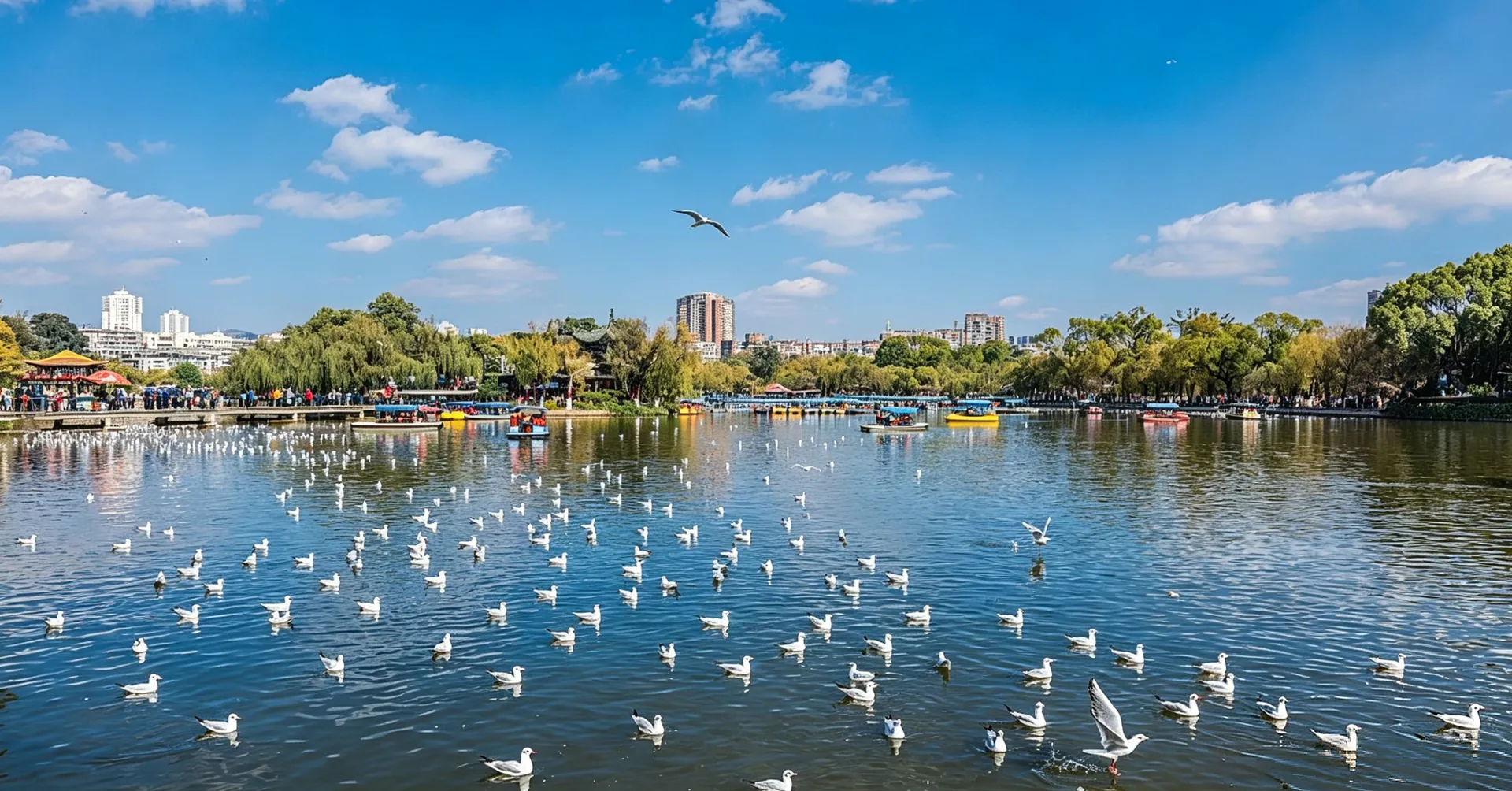
Kunming doesn't do seasons. The temperature hovers between 15 and 22°C year-round, the air is so clean by Chinese city standards that you can actually see stars, and the jacaranda trees explode into purple clouds every April. This is the **"City of Eternal Spring"** (春城 / Chūnchéng) — a highland cap
Where is Kunming?
Located in Southwest China (Yunnan) with a population of 8.6 million.
When to Visit - Month by Month
| Month | Temp | Rain | Crowd | Rating | Tips |
|---|---|---|---|---|---|
| Jan | 3~16°C | Low | Low | ★★ | Seagulls arrive |
| Feb | 5~18°C | Low | Low | ★★ | Pleasant |
| Mar | 8~22°C | Low | Medium | ★★★★ | Flowers bloom |
| Apr | 11~24°C | Low | Medium | ★★★★ | Warm. Good for SF |
| May | 14~25°C | Medium | Medium | ★★★★ | Mild. Rain begins |
| Jun | 16~26°C | High | Medium | ★★★ | Mushroom season |
| Jul | 17~25°C | High | Medium | ★★★ | Wild mushroom peak |
| Aug | 17~25°C | High | Medium | ★★★ | Rainy. Cool |
| Sep | 15~23°C | High | Medium | ★★★ | Still rainy |
| Oct | 11~21°C | Low | High | ★★★★★ | Best. Clear sunny |
| Nov | 6~18°C | Low | Medium | ★★★★ | Comfortable |
| Dec | 3~15°C | Low | Low | ★★ | Seagulls return |
Compare climate with other cities
Attractions - Ranked
Must-See (Don,t Miss These)
Stone Forest (Shilin) day trip
UNESCO site with thousands of towering limestone pillars like a petrified forest. Formed over 270 million years, covering 350 sq km.
| Detail | Info |
|---|---|
| Open | 7:30 AM - 6 PM |
| Admission | 130 yuan |
| Getting there | Bus from Kunming East (1.5h) |
| Time needed | Full day |
Tip: Go early (8 AM) to beat crowds. The Minor Stone Forest section is less crowded and more interesting. Wear good walking shoes.
Dianchi Lake & Western Hills cable car
Yunnan''s largest freshwater lake (300 sq km). The cable car offers stunning aerial views. Walk the cliffside Dragon Gate path carved into vertical rock.
| Detail | Info |
|---|---|
| Cable car | 70 yuan round trip |
| Getting there | Bus 44 from Kunming (45 min) |
| Time needed | Half-day |
Tip: Take cable car up to Western Hills, then walk the Dragon Gate path. Visit Nov-Mar to see migrating seagulls on the lake.
Green Lake Park (seagulls in winter)
Urban lake park in central Kunming. From Nov-Mar, thousands of migrating Siberian gulls cover the lake - feeding them by hand is a beloved local tradition.
| Detail | Info |
|---|---|
| Open | 24/7, free |
| Best time | November-March for gulls |
| Time needed | 1-2 hours |
Tip: Buy bread (5 yuan) from vendors to feed the gulls. Best feeding spot is the Jiuqu Bridge area.
Worth a Visit (If You Have Time)
Dounan Flower Market
The largest flower market in China and second-largest in the world. 100+ flower varieties sold by the kilo at incredibly low prices.
| Detail | Info |
|---|---|
| Open | 24/7 (retail 3-9 PM best) |
| Getting there | Metro Line 1 to Dounan |
| Time needed | 1-2 hours |
Tip: Visit the evening retail session (4-8 PM). 20 roses cost 10-15 yuan. Bring cash - some stalls don''t take cards.
Yunnan Nationalities Village
Open-air museum showcasing 26 of Yunnan''s ethnic minority groups. Each group has its own recreated village with traditional houses, costumes, and dance performances.
| Detail | Info |
|---|---|
| Open | 8:30 AM - 5:30 PM |
| Admission | 90 yuan |
| Getting there | Bus 44/73 from Kunming |
| Time needed | 3-4 hours |
Tip: Catch the daily dance performances (10:30 AM and 2:30 PM). The Dai and Yi villages are the most impressive.
Golden Temple
The largest bronze temple in China, built entirely from massive bronze plates. Moved to its hilltop location in 1637. Surrounded by a peaceful forest park.
| Detail | Info |
|---|---|
| Open | 7:30 AM - 6 PM |
| Admission | 30 yuan |
| Getting there | Bus 10/71 from Kunming |
| Time needed | 1.5-2 hours |
Tip: The temple shines brilliantly in direct sunlight - go on a clear day. Camellia gardens bloom Jan-Feb.
Suggested Itineraries
1 Day in Kunming
| Time | Activity |
|---|---|
| 8:00 AM | Bus to Stone Forest (1.5h) |
| 9:30-1:00 | Explore Stone Forest (Major + Minor) |
| 1:30-2:30 | Lunch near Stone Forest |
| 3:00-5:00 | Return to Kunming |
| 5:30-7:00 | Green Lake Park (seagulls in winter) |
| 7:30-9:00 | Dinner: crossing-the-bridge noodles |
2 Days in Kunming
| Time | Activity |
|---|---|
| 9:00-12:00 | Western Hills cable car + Dragon Gate |
| 12:30-1:30 | Lunch: Yunnan steam pot chicken |
| 2:00-4:00 | Dianchi Lake lakeside walk |
| 4:30-6:00 | Dounan Flower Market |
Day Trips
| Destination | Transport | Time | Why Go |
|---|---|---|---|
| Stone Forest | Bus 1.5h | Full day | 270M-yr limestone forest |
| Dali | HSR 2h | 2 days | Ancient town, Erhai Lake |
Food Guide
Kunming's cuisine draws from Yunnan's extraordinary biodiversity — wild mushrooms, exotic herbs, flowers you can eat, and the province's many ethnic culinary traditions all converge here.
The dish that put Yunnan on every Chinese food map — and the story matters. Legend says a scholar's wife discovered that a layer of chicken oil on the surface of the broth would keep it piping hot for the long walk across a bridge to her husband's study. The dish arrives as a ritual: a massive bowl of scalding chicken broth sealed under a film of oil, with side plates of paper-thin raw pork, raw quail eggs, ham, tofu skin, rice noodles, and vegetables. You add them in sequence — meat first (cooks instantly in the 100°C broth), then vegetables, then noodles. By the time you're done, you've cooked your own meal.
| Restaurant | Area | Notes |
|---|---|---|
| Jianxin Yuan (建新园) | Multiple locations | Founded 1906; the Kunming institution |
| Qiaoxiangyuan (桥香园) | Multiple locations | Modern chain with excellent broth quality |
A dish that requires its own piece of equipment: the qiguo — a clay pot with a central steam chimney. Chicken, ginger, and a few slivers of ham are placed inside with no water added. The pot is set over boiling water, and steam rises through the central chimney, condenses on the lid, and drips back down as the purest possible chicken broth. The result is a soup so clear it looks like tea, with a flavor so concentrated it tastes like chicken essence distilled into liquid form.
Yunnan is the wild mushroom capital of China — over 800 edible species grow here — and from June through September, Kunming enters mushroom madness. The jianshouqing (见手青 / "see-hand-blue"), a mushroom that turns indigo when cut, is the most famous (and mildly toxic if undercooked). Dry-cured ganba mushrooms (干巴菌) are the most aromatic. A mushroom hot pot — multiple varieties simmered together in chicken broth — is the ultimate rainy-season Kunming meal.
A Yunnan street-food staple. A thick disc of pounded glutinous rice is grilled over charcoal until puffed and blistered, then slathered with sesame paste, fermented bean paste, chili sauce, or a sweet rose-petal jam, wrapped around a youtiao (fried dough stick), and handed to you in a piece of paper. It costs ¥3–6, and you eat it standing on the sidewalk at 8 AM with a cup of soy milk. Kunming breakfast, perfected.
Yunnan's answer to Peking duck — and a legitimate rival. Yiliang County ducks are marinated, stuffed with local spices, and roasted over pine branches until the skin shatters and the meat is perfumed with smoky resin. Unlike Peking duck (where you eat only the skin wrapped in pancakes), Yiliang duck is chopped through the bone and eaten as whole pieces. It's more rustic, more aromatic, and a fraction of the price.
| Restaurant | Area | Notes |
|---|---|---|
| Xuecheng Yiliang Roast Duck (学成饭店) | Yiliang County / Kunming branches | The classic; worth the 1-hour trip to Yiliang for the original |
Where to Stay
| Area | Vibe | Price Range | Best For |
|---|---|---|---|
| Green Lake area (翠湖) | Colonial-era lanes, cafés, quiet, walkable, the city's most charming neighborhood | ¥300–1,200/night | Couples, solo travelers, atmosphere seekers |
| Nanping Street & Golden Horse Archway (南屏街/金马碧鸡坊) | Commercial heart, pedestrian streets, food lanes, metro hub | ¥250–800/night | First-time visitors, food travelers |
| Dianchi Resort Area (滇池度假区) | Lake-view hotels, spa resorts, hot springs, fresh air | ¥500–1,800/night | Relaxation, luxury, family trips |
| Guandu Ancient Town (官渡古镇) | Traditional Kunming life, old temples, morning markets, local breakfasts | ¥150–500/night | Culture immersion, budget travelers |
Getting Around
| Method | Route / App | Notes |
|---|---|---|
| From Changshui Airport (KMG) | Metro Line 6 → transfer to Line 3 | 40–50 min to city center, ¥8 |
| From Changshui Airport (KMG) | Taxi / DiDi | 35–45 min, ¥100–140 |
| Metro | Alipay Transport | 6 lines; Line 1 goes to Kunming South Station for high-speed trains |
| To Stone Forest | High-speed train from Kunming South (昆明南) to Shilin West (石林西) | 20 min, ¥20–30; then shuttle bus 10 min to the scenic area |
| City bus | Cash or Alipay | ¥1–2; useful for routes the metro doesn't cover |
Unique Experiences
| Experience | Why It's Worth It |
|---|---|
| Dounan Flower Market after dark | The 8:30 PM wholesale auction is sensory theater — millions of flowers changing hands, the air thick with the scent of roses and lilies. Buy a ¥5 flower crown and wear it |
| Feed the Siberian seagulls | November through March, thousands of gulls overwinter on Green Lake and Dianchi's Haigeng Dam. Buy gull food (¥2) and toss it skyward — they catch it midair |
| Zhuanxin Farmers Market (篆新农贸市场) | The greatest market in Yunnan for food — every strange mushroom, fragrant herb, pickled vegetable, grilled sausage, and steaming rice noodle stall in the province seems to have an outpost here. Go hungry, arrive by 9 AM |
| Anning Hot Springs (安宁温泉) | 40 minutes southwest of Kunming; natural mineral hot springs in forested surroundings. The "Number One Spring Under Heaven" (天下第一汤) has been bathing visitors since the Ming Dynasty |
| Yunnan Nationalities Museum | A quieter alternative to the Ethnic Village — excellent exhibits on all 26 of Yunnan's ethnic groups with superb English labeling |

Souvenirs
| Souvenir | What It Is | Where to Buy |
|---|---|---|
| Pu'er Tea (普洱茶) | Fermented Yunnan tea — raw (sheng, bright and complex) or ripe (shou, dark and earthy). Buy from a tea merchant who lets you taste first | Tea shops around Green Lake, specialized Pu'er markets |
| Flower Cake (鲜花饼) | Flaky pastry filled with rose-petal jam — Yunnan's most compulsively edible souvenir. The Jia Hua brand (嘉华) is the standard | Jia Hua bakery (multiple locations), airport |
| Dried Wild Mushrooms (菌子干货) | Dried ganba mushrooms, matsutake, morels — concentrated Yunnan flavor; pack well for travel | Zhuanxin Market, supermarkets |
| Ethnic Embroidery (民族刺绣) | Miao, Yi, and Bai minority textiles — purses, wall hangings, and clothing panels | Ethnic Village gift shops, Zhuanxin Market artisan stalls |
Before You Go - Checklist
Travel Styles
¥25 dorm beds (China's cheapest), ¥10 crossing-the-bridge noodles, free Green Lake Park. Kunming is the best budget base for Yunnan. Full budget guide →
The Stone Forest fascinates kids (rock formations with animal names). Green Lake Park's winter seagulls from Siberia are a magical sight. Full family guide →
Yunnan's capital — agriculture, tourism, and growing Southeast Asia trade links. Changshui Airport (KMG) has direct flights to Southeast Asian capitals. Full business guide →
"City of Eternal Spring" — 18°C year-round, China's most comfortable climate. Dianchi Lake promenade, flower market. Gentle altitude (1,890m). Full seniors guide →
Related
Routes: Golden Route | Themed routes Info: Visa | Payment | Internet
Have you been to Kunming?
What experience would you tell every traveler not to miss?
More Cities to Explore
Lijiang Travel Guide: Ancient Old Town, Jade Dragon Snow Mountain & Naxi Culture
The ultimate Lijiang travel guide for foreigners — UNESCO Old Town, Jade Dragon Snow Mountain hiking, Tiger Leaping Gorge trekking, Naxi ancient music, and the most romantic ancient town in China.
Dali Travel Guide: Erhai Lake, Three Pagodas & Bai Culture
The ultimate Dali travel guide for foreigners — cycle Erhai Lake, visit the Three Pagodas, explore the ancient town, discover Bai minority culture, and enjoy the laid-back lifestyle of Yunnan's most beautiful lakeside retreat.
Shenzhen Travel Guide: Tech Hub, Theme Parks & Coastal Escapes
The ultimate Shenzhen travel guide — OCT-LOFT creative district, Window of the World, Dapeng ancient fortress, coastal hiking, and the world's largest electronics market.
Get Weekly China Travel Tips
Join our newsletter for destination guides, travel hacks, visa updates, and insider recommendations delivered to your inbox.
No spam. Unsubscribe anytime.