Harbin — Where Winter Becomes Art
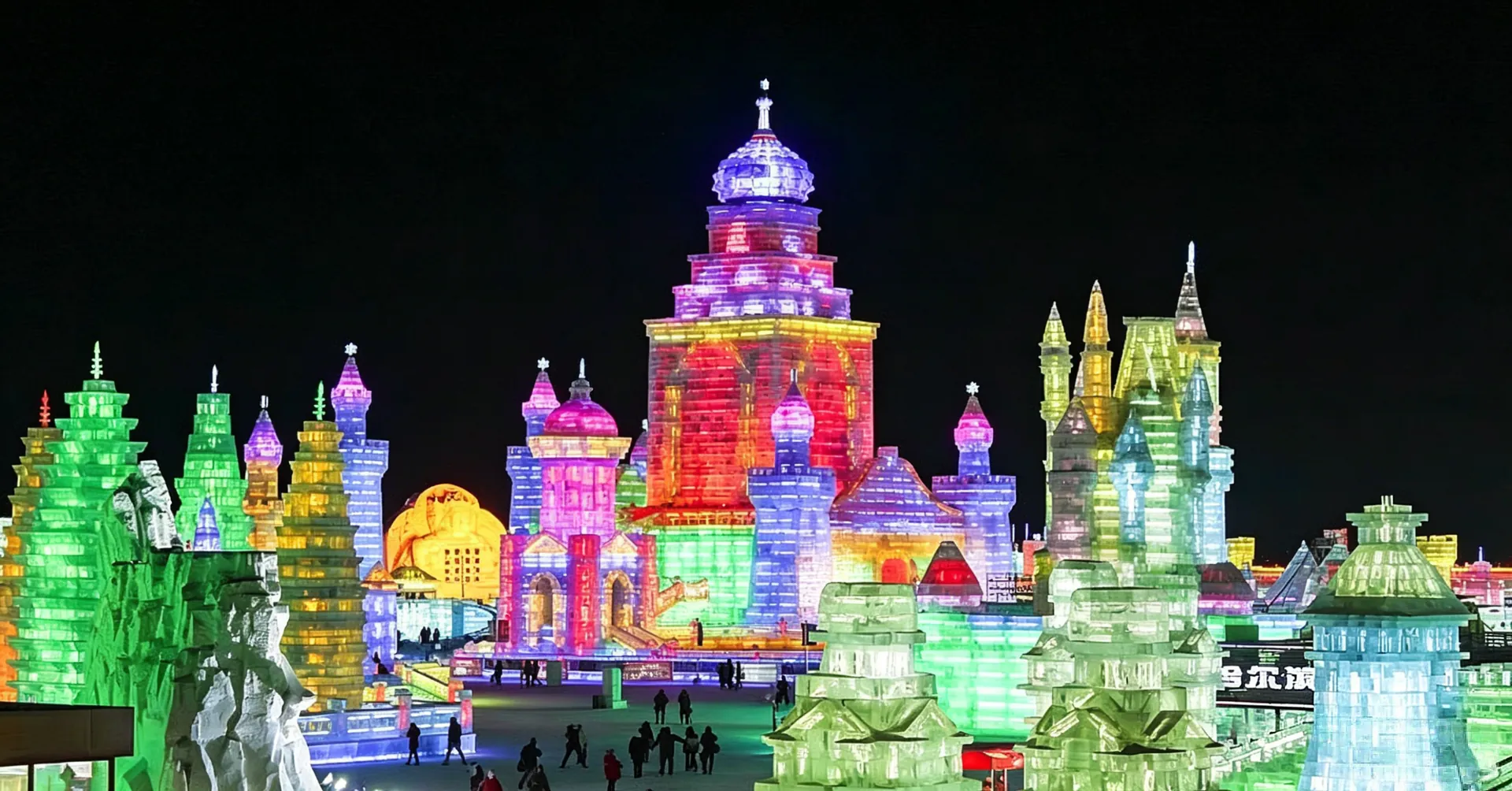
Harbin at -30°C is not a test of endurance. It's an invitation to witness something that doesn't exist anywhere else on Earth. Every winter, this northeastern Chinese city — frozen into the permafrost of Heilongjiang Province — transforms into the world's largest ice sculpture gallery. Blocks of ice
Where is Harbin?
Located in Northeast China (Heilongjiang) with a population of 10.0 million.
When to Visit - Month by Month
| Month | Temp | Rain | Crowd | Rating | Tips |
|---|---|---|---|---|---|
| Jan | -25~-10°C | Low | Low | ★★ | Ice Festival |
| Feb | -20~-8°C | Low | Medium | ★★★ | Ice peak. Very cold |
| Mar | -10~1°C | Low | Medium | ★★★ | Winter activities |
| Apr | 3~13°C | Low | Low | ★★ | Spring begins |
| May | 10~22°C | Low | Medium | ★★★★ | Mild. Pleasant |
| Jun | 17~28°C | Medium | High | ★★★★ | Summer warm |
| Jul | 20~30°C | High | High | ★★★ | Hottest. Summer |
| Aug | 18~27°C | High | High | ★★★ | Warm. Summer |
| Sep | 12~21°C | Low | Medium | ★★★★★ | Best. Sightseeing |
| Oct | 3~12°C | Low | Low | ★★ | Autumn. Colors |
| Nov | -8~1°C | Low | Low | ★★ | Cold. Fewer |
| Dec | -20~-10°C | Low | Low | ★★ | Winter begins |
Compare climate with other cities
Attractions - Ranked
Must-See (Don,t Miss These)
Ice and Snow World (winter only)
World''s largest ice and snow theme park. Massive ice castles, slides, and illuminated sculptures built from Songhua River ice blocks. Open late Dec-Feb only.
| Detail | Info |
|---|---|
| Open | Late Dec-Feb, 11 AM - 9:30 PM |
| Admission | 330 yuan |
| Getting there | Bus 29/47 from city center |
| Time needed | 3-5 hours |
Tip: Go after 4 PM when lights come on. Dress for -25C. Hand warmers and heated insoles are essential.
Saint Sophia Cathedral
Magnificent Russian Orthodox cathedral built in 1907 - the largest in the Far East. The green onion dome and red brick exterior are Harbin''s most iconic landmark.
| Detail | Info |
|---|---|
| Open | 8:30 AM - 5 PM |
| Admission | 20 yuan |
| Getting there | Walking distance from Central Street |
| Time needed | 30-45 min |
Tip: Visit at night when illuminated. The square becomes an ice sculpture site in winter.
Central Street (Zhongyang Dajie)
1.5km cobblestone pedestrian boulevard lined with 71 European-style buildings - Baroque, Byzantine, Russian, and Art Nouveau. Restaurants and bakeries line the street.
| Detail | Info |
|---|---|
| Open | 24/7, free |
| Getting there | Walk from most downtown hotels |
| Time needed | 2-3 hours |
Tip: Try Harbin sausage at the Qiu Lin store. The Modern Hotel sells the city''s best ice cream - even at -30C, people queue for it.
Worth a Visit (If You Have Time)
Sun Island Snow Sculptures
World''s largest snow sculpture exhibition. Massive snow sculptures (some 30m+ tall) carved by international artists.
| Detail | Info |
|---|---|
| Open | Late Dec-Feb, 8 AM - 5 PM |
| Admission | 260 yuan |
| Getting there | Cable car across Songhua River |
| Time needed | 3-4 hours |
Tip: Visit early January when sculptures are freshest. The cable car ride offers spectacular winter views.
Songhua River ice activities
When the river freezes solid (Dec-Mar), it becomes a playground for skating, ice biking, dog sledding, and ice bumper cars.
| Detail | Info |
|---|---|
| Open | Dec-Mar, 24/7 |
| Skating | 30 yuan |
| Getting there | Walk from Central Street to riverbank |
| Time needed | 1-3 hours |
Tip: The main activity area is in front of Central Street. Negotiate prices - they''re flexible on weekdays.
Harbin Polarland
World-class polar theme park with polar bears, penguins, beluga whales, and the only polar bear swimming tunnel in China.
| Detail | Info |
|---|---|
| Open | 8:30 AM - 5 PM |
| Admission | 160 yuan |
| Getting there | Bus 29 from Central Street |
| Time needed | 2-3 hours |
Tip: Beluga whale shows at 10, 12, 2, and 4 PM. The park is heated - good warm-up break on freezing days.
Suggested Itineraries
1 Day in Harbin
| Time | Activity |
|---|---|
| 9:00-10:30 | Saint Sophia Cathedral |
| 10:30-12:30 | Central Street walk + Harbin sausage |
| 1:00-3:00 | Sun Island Snow Sculptures (cable car) |
| 3:30-5:00 | Songhua River ice activities |
| 5:30-7:00 | Dinner: Russian cuisine |
| 7:00-9:30 | Ice and Snow World (night lights) |
2 Days in Harbin
| Time | Activity |
|---|---|
| 9:00-12:00 | Harbin Polarland |
| 12:30-1:30 | Lunch: guo bao rou |
| 2:00-5:00 | Heilongjiang Provincial Museum |
Day Trips
| Destination | Transport | Time | Why Go |
|---|---|---|---|
| Yabuli Ski | Train 3h | Full day | Largest ski resort |
| Volga Manor | Bus 1h | Half-day | Russian village |
Food Guide
Dongbei (northeast) cuisine is hearty, salty, sour, and built for -30°C winters. Portions are enormous, meat is central, and you'll leave every meal feeling like you've been fed by a grandmother who worries you're too thin.
The dish Harbin gave to China. Thin slices of pork loin are battered, double-fried until golden and shatteringly crisp, then tossed in a glossy sauce of sugar and white vinegar with slivers of ginger and carrot. The flavor is sweet-sour, the texture a perfect contrast of crunch and tender meat, and the origin story is pure Harbin: created in 1907 by a local chef adapting Chinese cooking to Russian tastes.
| Restaurant | Area | Notes |
|---|---|---|
| Lao Chu Jia (老厨家) | Central Street area | The originator — their guo bao rou is the benchmark against which all others are measured |
A garlicky, smoked pork-and-beef sausage with a deep mahogany color — the direct descendant of Lithuanian and Russian sausages brought by railway workers. It's eaten cold, sliced thin, as a snack or with beer. Every Harbin resident has a brand loyalty.
| Brand | Notes |
|---|---|
| Qiulin Lidaosi (秋林里道斯) | The classic; heavily smoked, intense garlic |
| Shangwei Hongchang (商委红肠) | Lighter smoke, more balanced; requires queuing — locals line up at dawn |
An ice-cream bar eaten outdoors in -30°C — and somehow, this makes perfect sense in Harbin. The Modern Hotel (马迭尔宾馆) has been selling these creamy milk popsicles from a street-facing window on Central Street since 1906. The cold keeps them frozen, the crowd keeps the queue warm, and eating an ice-cream bar in a parka while your breath crystallizes is an essential Harbin experience. ¥5 for the classic milk flavor. No, you don't sit down. You eat it while walking. Everyone does.
The ultimate Dongbei group meal. A massive cast-iron wok embedded in your table simmers a stew of fish, pork ribs, or chicken with potatoes, vermicelli noodles, tofu, and cabbage. Cornbread (bingzi) is slapped against the side of the hot wok and steamed in place. The broth reduces to a thick, savory intensity over the course of the meal. It's communal, it's primal, and it will leave you incapable of movement.
Traditionally prepared for the Lunar New Year pig slaughter, this is rural Dongbei on a plate: tender slices of fatty pork, house-made blood sausage, and sour pickled Napa cabbage (suancai), all simmered together in a clay pot. The pickled cabbage cuts through the richness of the pork, the blood sausage adds earthiness. It's rustic, unpretentious, and the dish that best expresses the Dongbei culinary philosophy: nothing wasted, everything shared.
Where to Stay
| Area | Vibe | Price Range | Best For |
|---|---|---|---|
| Central Street area (中央大街) | European-themed hotels, walkable to major sights, the heart of the action | ¥300–1,200/night | First-time visitors, winter festival-goers |
| Near Ice and Snow World (冰雪大世界周边) | Convenient for the ice park; more limited dining options | ¥400–1,500/night | Ice and Snow World-focused trips |
| Songbei District (松北区) | High-end resort hotels, hot spring hotels, quieter | ¥500–1,800/night | Luxury, families, relaxation |
Getting Around
| Method | Route / App | Notes |
|---|---|---|
| From Taiping Airport (HRB) | Airport bus (lines 1, 2, 3 to different parts of the city) | 50–70 min, ¥20 |
| From Taiping Airport (HRB) | Taxi / DiDi | 40–60 min, ¥120–160 |
| Metro | 3 lines (expanding); Line 2 connects Central Street to Ice and Snow World | ¥2–6 per ride |
| Taxi / DiDi | Widely available | Most trips within the city center cost ¥10–30 |
Unique Experiences
| Experience | Why It's Worth It |
|---|---|
| See both day and night Ice and Snow World | Arriving at 2 PM means you experience the translucent blue-white sculptures in sunlight and the LED wonderland after dark — two completely different parks |
| Eat a Modern Popsicle on Central Street at -30°C | It doesn't melt. It tastes better. Everyone is doing it. You're holding a 118-year-old tradition in your gloved hand |
| Dog sled or ice slide on the frozen Songhua River | The river becomes a kilometers-long carnival — the ice slide (冰滑梯) is genuinely thrilling, and the dog sleds (拉雪橇) are run by local families |
| Russian dinner at Huamei Restaurant (华梅西餐厅) | Opened in 1925, this is authentic Tsarist-era Russian fine dining: borscht, beef stroganoff, caviar, black bread. The interior looks like it hasn't changed since Stalin's time — because it mostly hasn't |
| Volga Manor day trip (伏尔加庄园) | A Russian-themed cultural park 40 minutes outside the city — St. Petersburg-style palaces, a replica wooden church, and winter sleigh rides through birch forests |

Souvenirs
| Souvenir | What It Is | Where to Buy |
|---|---|---|
| Harbin Red Sausage (哈尔滨红肠) | Vacuum-sealed for travel — the taste of smoked garlic travels well | Qiulin Lidaosi (秋林里道斯) stores, airport |
| Russian Sourdough Bread (大列巴) | A massive, dense, tangy bread loaf — a Harbin staple since the railway era | Qiulin Bakery (秋林公司), Central Street |
| Russian Matryoshka Dolls (套娃) | Traditional nesting dolls — imported from across the border | Central Street souvenir shops |
| Black Fungus (黑木耳) | Heilongjiang's premium dried wood-ear mushrooms — prized throughout China for their texture | Local markets, supermarkets |
| Wild Hazelnuts (野生榛子) | Foraged from Heilongjiang's forests — nutty, sweet, and intensely local | Local markets, snack shops |
Before You Go - Checklist
Travel Styles
¥40 dorm beds, ¥5 Modern Popsicle on Central Street, free Stalin Park and Songhua River ice activities. Winter budget travel at its most magical. Full budget guide →
Ice and Snow World is a fairy tale for kids. The Siberian tiger park and Sun Island snow sculptures are family favorites. Bundle up — layers for everyone. Full family guide →
Northeast China's commercial hub and Russian trade gateway. Taiping Airport (HRB) connects to Russian Far East cities. Winter business travel requires serious cold-weather gear. Full business guide →
Ice and Snow World is walkable with rest stops. Central Street is flat. Extreme cold (-25°C) is the main challenge — dress in layers and limit outdoor time to 2-hour blocks. Full seniors guide →
Related
Routes: Golden Route | Themed routes Info: Visa | Payment | Internet
Have you been to Harbin?
What experience would you tell every traveler not to miss?
More Cities to Explore
Kunming Travel Guide: City of Eternal Spring, Stone Forest & Flowers
The ultimate Kunming travel guide — Stone Forest karst wonderland, Dianchi Lake, Dounan flower market, wild mushroom hot pot, and Yunnan's ethnic cultures. China's spring city.
Qingdao Travel Guide: Beer, Beaches & German Heritage
The ultimate Qingdao travel guide — Tsingtao Beer Museum, fresh draft beer, Badaguan's European villas, Laoshan Mountain, and golden beaches. China's sailing city.
Xiamen Travel Guide: Gulangyu Island, Beaches & Minnan Culture
The ultimate Xiamen travel guide — car-free Gulangyu Island, coastal cycling, Nanputuo Temple, Shapowei art district, and delicious Minnan cuisine. China's most romantic island city.
Get Weekly China Travel Tips
Join our newsletter for destination guides, travel hacks, visa updates, and insider recommendations delivered to your inbox.
No spam. Unsubscribe anytime.