China Nature & Landscape Tour – Mountains, Rivers & Gorges
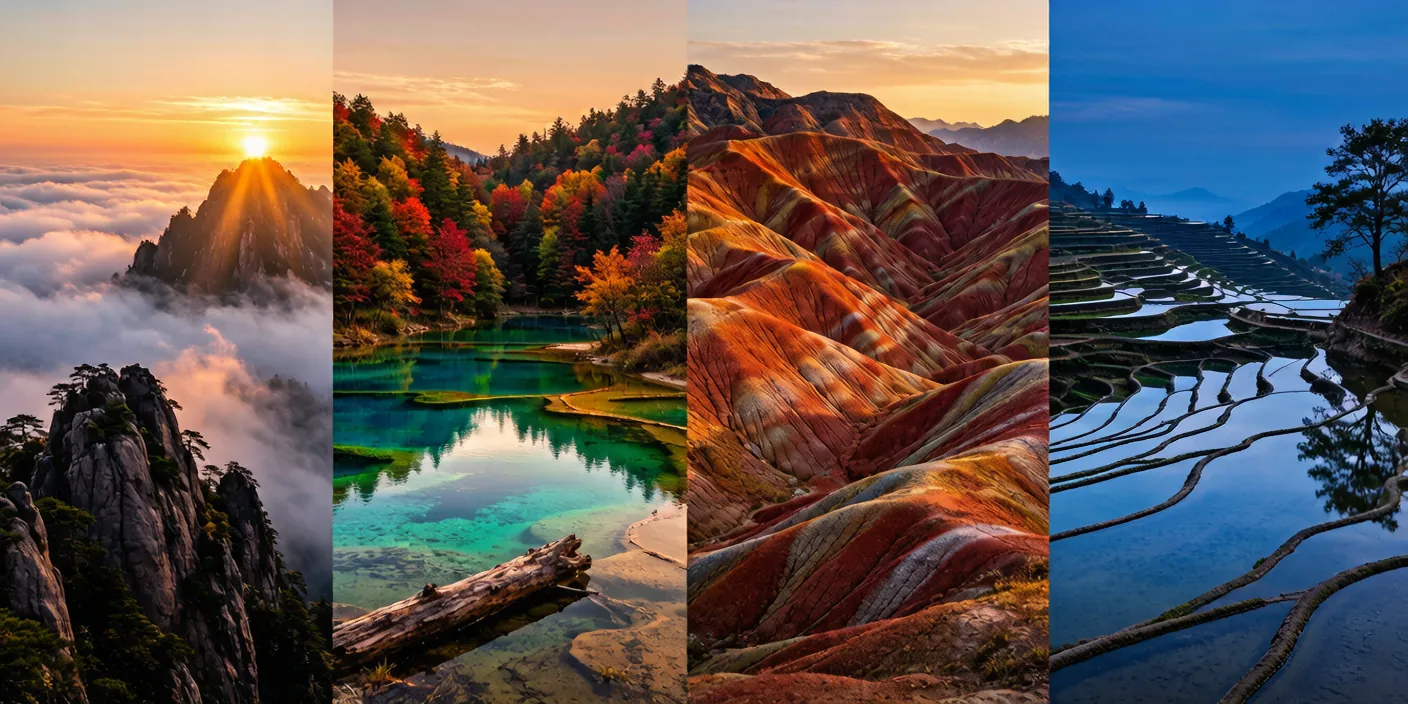
The China most travelers see — Beijing, Shanghai, Xi'an — is urban. But beyond the cities lies a country of staggering natural beauty: limestone peaks rising from misty rivers, granite spires that inspired Avatar, sacred mountains where monks and poets walked for millennia, and turquoise lakes in valleys that feel like another planet.
These five routes cover China's greatest landscapes. Each is designed to be self-contained — pick one, pack hiking boots, and go.

Route 1: Classic Karst & River (7 Days)
Guilin → Yangshuo → Longji Rice Terraces
The landscape that appears on China's ¥20 note — and in every Chinese ink-wash painting you've ever seen. Karst peaks erupt from emerald rivers like dragon teeth. This is China's most accessible and photogenic natural scenery.
| Day | Location | Activity |
|---|---|---|
| 1 | Guilin | Arrive. Elephant Trunk Hill. Evening: Two Rivers Four Lakes night cruise |
| 2 | Li River | Full-day Li River cruise (Guilin → Yangshuo, 4 hrs). The most dramatic karst scenery on Earth. Check into Yangshuo countryside guesthouse |
| 3 | Yangshuo | E-scooter rental (¥50/day). Ten-Mile Gallery cycling loop. Yulong River bamboo raft (90 min of silence). Farmhouse lunch in Jiuxian village |
| 4 | Yangshuo | Xianggong Mountain sunrise (the single best Li River viewpoint). Afternoon: free cycling exploration |
| 5 | Longji Rice Terraces | Bus to Longji (2.5 hrs). Check into Ping'an or Dazhai guesthouse. Afternoon: hike between viewpoints. Sunset over water-filled terraces |
| 6 | Longji | Sunrise over terraces. Hike Ping'an → Dazhai trail (3–4 hrs through Yao villages). Evening: return to Guilin |
| 7 | Guilin | Depart |
Route 2: Zhangjiajie & Avatar Mountains (5 Days)
Zhangjiajie National Forest Park
The floating mountains of Pandora in James Cameron's Avatar were inspired by these quartz-sandstone pillars. Over 3,000 of them rise from a subtropical forest floor, wrapped in mist. This is one of the most surreal landscapes on the planet.
| Day | Area | Activity |
|---|---|---|
| 1 | Zhangjiajie City | Arrive. Evening: explore the city. Try xiachaguo (土家下茶果), a Tujia minority tea snack |
| 2 | Yuanjiajie (袁家界) | Bailong Elevator (world's tallest outdoor lift, 326m). Avatar Hallelujah Mountain. First Bend Bridge. The iconic Zhangjiajie views |
| 3 | Tianzi Mountain (天子山) | Cable car up. Imperial Writing Brush Peaks. Cloud Sea viewpoints. Descend via the 10-Mile Natural Gallery trail |
| 4 | Grand Canyon & Glass Bridge | Zhangjiajie Grand Canyon. Walk the glass bridge spanning the canyon (430m long, 300m high). Afternoon: Yellow Dragon Cave |
| 5 | Tianmen Mountain (天门山) | "Heaven's Gate" — a natural arch in the mountain. The world's longest cable car (7.5 km from the city center). The 999-step staircase to Heaven's Gate. Evening: depart |

Route 3: Sacred Mountains Circuit (10 Days)
Huangshan → Mount Tai → Emeishan
China's sacred mountains have drawn pilgrims, poets, and painters for thousands of years. This route climbs three of the most significant: Huangshan (the most beautiful), Mount Tai (the most historically important), and Emeishan (the most spiritually resonant).
| Day | Mountain | Experience |
|---|---|---|
| 1–3 | Huangshan (黄山 / Yellow Mountain) | Granite peaks, twisted pines, sea of clouds, hot springs. Stay overnight on the summit for sunrise. Cable car available (you hike; the mountain rewards). Anhui Province |
| 4–6 | Mount Tai (泰山 / Tai Shan) | The most sacred of China's Five Great Mountains. 6,600-step staircase to the summit. Confucius climbed here. 72 emperors made pilgrimages. Shandong Province |
| 7–10 | Emeishan (峨眉山) | One of China's Four Sacred Buddhist Mountains. Misty forests, ancient temples, wild monkeys. Summit at 3,099m with Golden Summit temple. Sichuan Province |
Route 4: Yunnan Nature Explorer (10–12 Days)
Kunming → Dali → Lijiang → Shangri-La
Yunnan is China's most biodiverse province — snow mountains, highland lakes, alpine meadows, and deep gorges, connected by ancient Tea Horse Road towns. This route climbs from 1,890m (Kunming) to 3,300m (Shangri-La).
| Day | Location | Activity |
|---|---|---|
| 1–2 | Kunming | Stone Forest (UNESCO, 270-million-year-old limestone formations). Dianchi Lake. Acclimatize to altitude |
| 3–4 | Dali | Erhai Lake cycling. Cangshan Mountain hiking trails. Bai minority old town. Altitude: 1,970m |
| 5–7 | Lijiang | Jade Dragon Snow Mountain (5,596m). Tiger Leaping Gorge — one of the deepest gorges on Earth. Hike the high trail (2 days recommended). Altitude: 2,400m |
| 8–10 | Shangri-La | Songzanlin Monastery (Tibetan Buddhist, "Little Potala Palace"). Pudacuo National Park (alpine meadows, lakes). Altitude: 3,300m — move slowly at this elevation |

Route 5: Jiuzhaigou & Western Sichuan (7 Days)
Chengdu → Jiuzhaigou → Huanglong
Jiuzhaigou's turquoise lakes and multi-tiered waterfalls are the most beautiful alpine scenery in China. In autumn, the forests explode into gold and crimson. The valley feels like a fairy tale.
| Day | Location | Activity |
|---|---|---|
| 1 | Chengdu | Arrive. Panda Base. Acclimatize. Hot pot dinner |
| 2 | Chengdu → Jiuzhaigou | Fly Chengdu → Jiuzhaigou Huanglong Airport (1 hr). Check into hotel near park entrance |
| 3 | Jiuzhaigou (九寨沟) | Full day in Jiuzhaigou Valley. Five-Flower Lake, Panda Lake, Nuorilang Waterfall. The park bus system makes it easy. Altitude: 2,000–3,100m |
| 4 | Jiuzhaigou | Second day — revisit favorite spots in different light. Zharu Valley for quieter trails |
| 5 | Huanglong (黄龙) | Travertine pools cascading down a valley — golden, turquoise, emerald. Altitude: 3,200–3,600m. Cable car available for the ascent |
| 6 | Songpan Ancient Town | Horse trekking through alpine valleys. Tibetan and Qiang minority culture. Qing Dynasty stone city walls |
| 7 | Return to Chengdu | Fly or drive back to Chengdu. One last hot pot before departure |

Best Time to Visit Each Destination
| Destination | Best Months | Why | Avoid |
|---|---|---|---|
| Guilin / Yangshuo | Apr–Oct | Lush green; May–Jun for misty river scenes | Jul–Aug (hot, domestic tourists) |
| Zhangjiajie | Apr–May, Oct–Nov | Spring blooms, autumn colors | Jul–Aug (rain), Dec–Feb (snow closures) |
| Huangshan | Apr–May, Sep–Nov | Sea of clouds, autumn colors, comfortable hiking | Jul–Aug (rain), winter (ice/snow steps) |
| Mount Tai | Apr–May, Oct | Pleasant temperatures, clear views | Jul–Aug (heat), Jan–Feb (ice) |
| Emeishan | Apr–Jun, Sep–Oct | Rhododendrons in spring, golden autumn | Jul–Aug (rain, leeches on trails) |
| Yunnan Route | Mar–May, Oct–Nov | Wildflowers, snow mountains visible | Jul–Aug (monsoon) |
| Jiuzhaigou | Oct | Peak autumn foliage — the most beautiful month | Winter (some areas closed) |
Difficulty & Fitness Level Guide
| Route | Difficulty | Fitness Required | Key Challenge |
|---|---|---|---|
| Guilin/Yangshuo | Easy | Minimal — cycling and bamboo rafts | None |
| Zhangjiajie | Moderate | Moderate — lots of stairs | Leg fatigue from stairs |
| Sacred Mountains | Challenging | High — 6,600+ steps on some mountains | Endurance, knee strain |
| Yunnan Explorer | Moderate–Challenging | Moderate–High — altitude | Altitude sickness above 3,000m |
| Jiuzhaigou | Easy–Moderate | Low–Moderate — altitude | Altitude at Huanglong (3,600m) |
Frequently Asked Questions
Do I need a guide for hiking in China?
For major scenic areas (Guilin, Zhangjiajie, Jiuzhaigou) — no. Trails are well-marked and cable cars handle the steep sections. For backcountry hiking (Tiger Leaping Gorge, Emeishan summit), a guide is not required but can be helpful for navigation and cultural context. For Tibet treks and remote western Sichuan, a guide and permits are mandatory.
What should I pack for nature trips in China?
Waterproof hiking boots (non-negotiable), rain jacket (mountain weather changes fast), layers (altitude drops temperature 6°C per 1,000m), trekking poles (save your knees on stairs), and a power bank (your phone is also your ticket and payment system). Altitude sickness medication if going above 3,000m.
Are China's natural sites crowded?
Yes — Jiuzhaigou receives 5 million visitors annually. The solution: visit on weekdays, arrive at opening time (most visitors arrive 10–11 AM), and hike the slightly longer trails. On the busiest routes, walking one extra kilometer eliminates 90% of the crowd.
The Mountains Are Calling
China's natural landscapes are the equal of any on Earth — and far less visited by international travelers than they deserve to be. Pick a route. Pack your boots. The karst peaks, sacred summits, and turquoise lakes have been waiting for you for a few hundred million years.
Which China landscape calls to you?
The ink-wash karst of Guilin? The Avatar spires of Zhangjiajie? The sacred peaks of Huangshan? Tell us in the comments. Also explore our food routes, history routes, and Golden Route for the full China experience.
Related Routes
China Food Tour – Best Culinary Routes for Foreigners
Eat your way through China. Four curated food routes covering Sichuan spicy trail, Cantonese dim sum tour, northern classics, and Yunnan ethnic cuisine. Includes must-try dishes by city.
Ancient China History Tour – Following the Dynasties
Walk through 3,000 years of Chinese history. Four curated history routes covering imperial capitals, the Great Wall, ancient water towns, and UNESCO World Heritage sites.